

SOL Components Secures 100% Patent for QuickGrip Solar Mounting Systems Rail Technology

Le solar mounting systems industry saw a significant intellectual property development in September 2026 when SOL Components, a subsidiary of Create Energy, secured a U.S. patent for its QuickGrip solar panel rail. The patent, issued by the U.S. Patent and Trademark Office on September 1, covers the mechanical design behind a technology that aims to cut labor requirements and eliminate loose hardware during mechanical tracker installation .
The patent filing details a hat roll-formed high-strength light-gauge steel rail engineered to mount directly to tracker torque tubes. A key feature of the design involves preassembled panel rail brackets that are nested during shipping and unfold on site without tools. Once unfolded, the brackets allow an installer to secure the rail to the torque tube using a single carriage bolt across the bottom of the tube .
According to the patent, this single-bolt interface eliminates the need for installers to slide hardware over long sections of tube or balance separate nuts and bolts from above. The bracket design also automatically squares the panel rail against the torque tube, removing the need for workers to align rails using a carpenter’s square or straight edge .
Indexed Solar Mounting Systems for Faster Module Installation
To position and secure photovoltaic modules, the QuickGrip rail includes stamped indexing flanges and tabs integrated directly into the roll-formed profile. The indexing flanges box in a module frame along the short-side direction, while adjacent tabs hold the frame in the perpendicular direction. The flanges and tabs combine to create a way for modules to hang in place before final fastening .
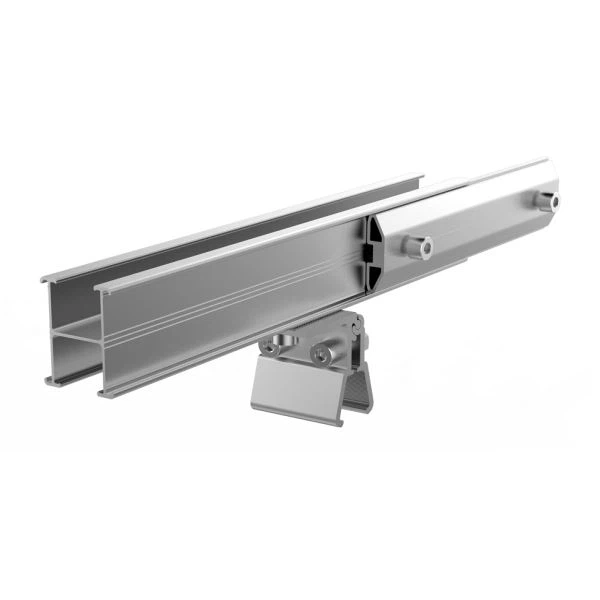
Le solar mounting systems support modules in multiple tracker architectures, including one-in-portrait and two-in-portrait layouts. For 2P deployments, multiple QuickGrip rails can be joined to connect to modules on both sides of the torque tube .
Create Energy says the QuickGrip rails can reduce tracker and electrical balance of systems installation time by as much as 50 percent when paired with the company’s integrated eBOS solution .
“This patent reflects the ingenuity and dedication of our engineering, product development, and operations teams,” said Create Energy CEO Dean Solon. “Innovation is at the core of our mission, and securing this patent demonstrates our continued investment in technologies that improve solar deployment, reduce costs, and create long-term value for customers and partners” .
Flat-Roof Inverter Racking Addresses Solar Mounting Systems Gap
In a related development addressing commercial solar mounting systems challenges, Opsun Systems launched its SunRail Inverter Rack in July 2026. The solution is engineered to support and house string inverters directly alongside rooftop arrays, eliminating what the company describes as “unstandardized field improvisation” often associated with mounting heavy string inverters on commercial rooftops .
The aluminum structure is optimized for severe environmental loading on low-slope surfaces up to 7 degrees. Manufactured using 6000-series structural aluminum and paired with 306 stainless steel bolts and nuts, the frame is rated to withstand maximum wind loads up to 180 mph and maximum snow loads up to 100 PSF .
“What we kept hearing from EPCs was that inverter placement on the roof was still a field problem, no standardized solution, a lot of improvisation,” said François Gilles-Gagnon, president of Opsun Systems. “The SunRail platform lent itself well to solving that” .
Global Solar Mounting Systems Market Expansion
These innovations come as the global solar mounting systems market continues to expand. ARRAY Technologies recently inaugurated a new 216,000-square-foot manufacturing facility in Albuquerque, New Mexico, representing an investment exceeding $50 million. The facility is approximately three times the size of its previous location and will support approximately 300 jobs in production, assembly, design, engineering, and customer service .
The company reported a record backlog of $2.5 billion, with new products including OmniTrack, SkyLink, Hail XP, and APA contributing 50 percent of Q2 2026 orders. ARRAY also plans to acquire Affordable Wire Management for approximately $203 million, extending its business into balance-of-system components and opening opportunities in the growing BESS and data center markets .
As solar mounting systems continue to evolve, the industry’s focus on reducing installation labor, improving structural performance, and addressing emerging applications like agrivoltaics and inverter mounting will define competitive advantage in the years ahead. For project developers and EPCs, staying informed about these technological developments is essential for optimizing both capital expenditure and long-term operational performance.
About ALV Solar
ALV Solar is a leading provider of solar mounting systems, delivering one-stop mounting solutions for global clients. Our products meet international certification standards including SGS/CE, AS/NZS1170, JIS4955:2011, and ISO9001. We specialize in rooftop, ground-mount, and carport solar mounting systems designed for wind loads up to 60 m/s and snow loads up to 4 kN/m², with a 25-year service life and 12-year warranty. From initial CAD design to final installation guidance, ALV Solar delivers customized solutions tailored to your project’s specific requirements.
Frequently Asked Questions About Solar Mounting Systems
1. What is the QuickGrip solar mounting systems rail and how does it work?
The QuickGrip rail is a hat roll-formed, high-strength light-gauge steel rail designed by SOL Components for mechanical tracker installations. It mounts directly to tracker torque tubes and features preassembled panel rail brackets that are nested during shipping and unfold on site without tools. Installers secure the rail to the torque tube using a single carriage bolt, which automatically squares the rail and eliminates the need for manual alignment . This innovation can reduce tracker and electrical balance of systems installation time by up to 50 percent when paired with integrated eBOS solutions.
2. How do indexed flanges improve solar mounting systems installation efficiency?
Indexed flanges and tabs are stamped directly into the roll-formed profile of the QuickGrip rail. These features box in a module frame along the short-side direction while adjacent tabs hold the frame perpendicular. Together, they allow modules to hang in place before final fastening, eliminating the need for workers to manually position and hold panels during installation. This design supports both one-in-portrait and two-in-portrait tracker architectures, making solar mounting systems more versatile across different project layouts .
3. What are the key structural specifications of modern commercial solar mounting systems?
Modern commercial solar mounting systems like the SunRail Inverter Rack are engineered for severe environmental loading. Key specifications include maximum wind load ratings up to 180 mph and maximum snow load ratings up to 100 PSF. These systems typically use 6000-series structural aluminum paired with 306 stainless steel bolts and nuts for corrosion resistance. They are optimized for low-slope surfaces up to 7 degrees, making them suitable for flat commercial rooftops where traditional mounting approaches may face structural or waterproofing challenges .
4. How is the global solar mounting systems market expected to grow?
The global solar mounting systems market is projected to grow from $44.5 billion in 2024 to $68.2 billion by 2034, representing a compound annual growth rate of 4.4 percent. The Asia-Pacific region continues to dominate, with projections showing the regional market will grow from $31.5 billion in 2025 to $51.6 billion by 2035. Growth is driven by falling PV costs, rising renewable energy targets, and increasing scale of utility solar projects. Fixed-tilt mounts accounted for 68 percent share among projects exceeding 100 MW in 2024 .
5. What should EPCs look for when selecting solar mounting systems suppliers?
When evaluating solar mounting systems suppliers, EPCs should prioritize demonstrable field performance and documented installation productivity gains, modular and pre-assembled designs that reduce on-site labor, end-to-end support including digital validation tools and installer training programs, and certified structural calculations for zone-specific wind and snow loads. Suppliers with large-scale production capacity, proven product quality, and extensive project track records are expected to strengthen their market position as the industry consolidates .
Contact ALV Solar(sales08@xmalv.com) today to discuss how our solar mounting systems can reduce your installation costs, improve structural performance, and accelerate your project timeline.