

Are Solar Carports Worth the Investment? 5 Key Factors for Buyers (2026)

When businesses or homeowners search for solar carports, the most pressing question is almost always about return on investment. Is a dual-purpose structure that generates electricity while shading vehicles actually worth the premium over a standard ground-mount or rooftop system? The answer depends on your energy consumption patterns, available space, and how you factor in the non-energy benefits.
The Financial Reality of Solar Carports
The economics of solar carports differ significantly from rooftop solar. The structural adder—the cost of steel, foundations, and elevated labor—adds roughly $0.40 to $0.70 per watt to a standard commercial PV system . For a typical commercial installation, this means a total installed cost of $2.00 to $2.40 per watt DC for a standard carport, and up to $2.50 to $3.50 per watt for premium designs like waterproof decks or cantilevered single-post structures .
However, the payback math becomes compelling when you consider how the energy is used. A 500 kW carport in a location like Dallas produces roughly 700,000 to 750,000 kWh per year . If the adjacent building has a steady daytime load and can consume 70% to 90% of that generation on-site, the avoided energy costs at commercial rates can drive a simple payback in the 7 to 12-year range for commercial projects, depending on incentives .
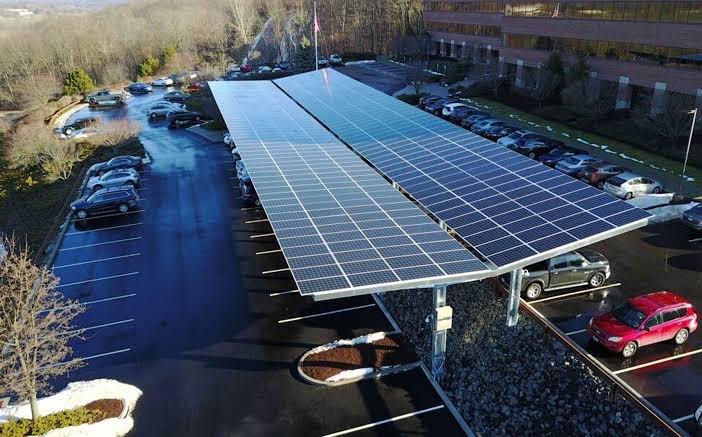
Why Solar Carports Are Not Just About Electricity
Buyers often overlook the ancillary benefits that improve the ROI of solar carports. Unlike a traditional ground-mount array, a carport provides tangible asset protection. It shields vehicles from hail, reduces UV degradation of paint and interiors, and lowers ambient temperatures in adjacent areas.
For commercial properties, this translates into higher tenant satisfaction and potentially higher parking revenue. More importantly, the structural columns serve as an ideal mounting point for EV charging stations. Running conduit and trenching during the initial construction phase costs roughly $0.10 to $0.20 per watt; retrofitting the same infrastructure later can cost $1,000 to $3,000 per charging port . If your facility is planning for fleet electrification or customer charging, the carport becomes a strategic infrastructure investment rather than just a power plant.
Critical Design and Structural Considerations
Search queries for solar carports frequently include questions about weather resistance and safety. Buyers must ensure the structure is engineered for the specific site. Standard designs are typically made from hot-dip galvanized steel for durability, with aluminum offering a lighter-weight alternative . The structure must be calculated for local snow and wind loads, often using open-building provisions like ASCE 7-22 to account for the unique pressure coefficients of an elevated canopy .
A common point of failure in procurement is the definition of “waterproof.” Many solar carports are designed with gutters and drainage systems, but buyers must explicitly confirm whether the proposal includes a weatherproof membrane or if the modules themselves are the only barrier . If rain protection is a requirement, specify the glazing or under-panel roofing assembly in the design brief.
Why ALV Solar Excels in Solar Carport Structures
Selecting the right structural partner is critical for solar carports, where safety and longevity are paramount. ALV Solar designs and manufactures carport mounting systems engineered for demanding environments. Our structures utilize high-strength steel with advanced anti-corrosion treatments, certified to withstand wind loads up to 60 m/s and snow loads up to 4 kN/m².
We understand that every parking lot has unique constraints. ALV Solar provides custom CAD design to optimize column spacing, clearance heights, and module layout, ensuring your carport accommodates standard vehicles, trucks, or specialized equipment. Our systems are pre-engineered for seamless integration with EV charging infrastructure, allowing you to future-proof your investment with built-in cable management and mounting points. With a 25-year service life and comprehensive structural calculations, ALV Solar delivers solar carports that protect your assets and maximize your energy yield.
Những câu hỏi thường gặp
1. How much does a solar carport cost in 2026?
For planning, use $2.00 to $2.40 per watt DC for a standard commercial solar carport. Premium designs with waterproof decks or high-wind engineering can range from $2.50 to $3.50 per watt . Residential-scale carports (5 kW) typically cost $15,750–$22,500 before incentives .
2. Can a solar carport be installed on an existing parking lot?
Yes, but foundation design is critical. Options include drilled piers, driven piles, or ballasted systems. The choice depends on soil conditions, wind uplift requirements, and whether the lot is on a grade. A site-specific structural review is mandatory .
3. Are solar carports waterproof?
Not automatically. Most structures include gutters and downspouts to manage runoff, but a fully waterproof membrane beneath the modules is often an optional upgrade. If dry parking is a requirement, specify the waterproofing assembly explicitly in your procurement documents .
4. How much parking space is lost to the structure?
The number of lost spaces is minimal. Columns typically occupy the equivalent of a few stalls, but the total depends on the span width and layout. A well-designed layout can cover 90%+ of the parking area while maintaining safe drive aisles .
5. Can EV chargers be added later to a solar carport?
Yes, but it is far cheaper to prepare for them during construction. Installing conduit and trenching while the ground is open costs roughly $0.10–$0.20 per watt. Retrofitting later can cost $1,000–$3,000 per port due to the need to re-open the lot .