

Solar Mounting Systems Market Accelerates as Schletter Unveils 70% Faster Installation Technology at Intersolar 2026

The solar mounting systems industry witnessed a significant technological leap at Intersolar Europe 2026, where Schletter Group presented a preview of its upcoming product generation for utility-scale projects. The German manufacturer introduced a slide-in rafter system designed to reduce overall installation time by approximately 30 percent, while module installation itself is up to 70 percent faster than conventional systems .
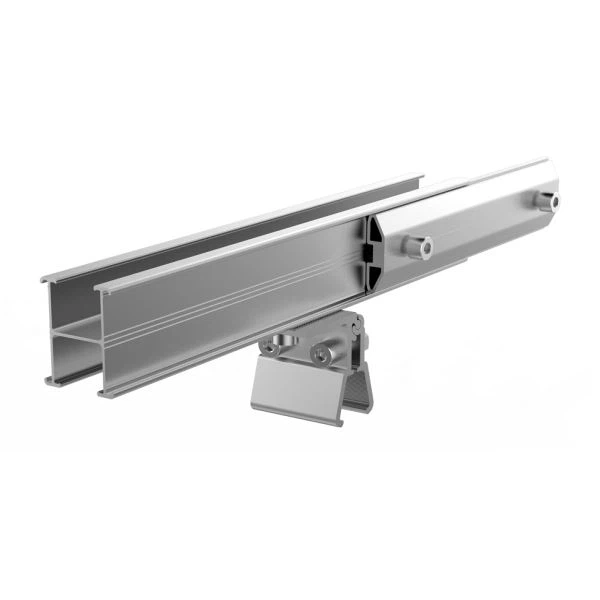
Instead of placing and fastening modules from above, the new solar mounting systems enable the vertical installation of up to three modules by a single installer using a guided slide-in mechanism. Pre-assembled self-locking clamps are attached to the support structure, and modules are inserted from below. Integrated locking mechanisms hold them securely in place before final fastening, which can be completed from either above or below .
“This approach simplifies installation processes and reduces labor requirements on site,” said Daniel Rehm, CEO of Schletter. The system geometry has also been designed to maximize exposure of the rear side of bifacial modules, significantly reducing backside shading—a critical consideration as bifacial technology gains market share across utility-scale solar mounting systems deployments .
Agri-PV Solar Mounting Systems Gain Momentum
Schletter also presented an extension of its established 1P tracker for the agrivoltaic market. The enhanced solar mounting systems will achieve a minimum ground clearance of 2.1 meters even at tilt angles of up to 60 degrees, meeting a key requirement in many European Agri-PV funding and approval schemes .
The increased clearance allows machinery and personnel to pass beneath the system regardless of tracker position. At the same time, the greater distance between the lower edge of the module and the ground improves light distribution. The enhanced 1P tracker will be added to the standard product line later this year, with project-specific configurations already available .
“Agri-PV remains strongly trending,” emphasized Thomas Dorsch, Global Director Sales Ground Mount at Schletter. “Especially from Italy, we received very concrete inquiries about this solution. There, sufficient ground clearance is often a prerequisite for agri-PV projects to be implemented at all” .
The convergence of agriculture and solar mounting systems represents one of the most dynamic growth segments in the renewable energy sector. According to industry analysts, agrivoltaic installations are projected to exceed 10 GW globally by 2030, driven by land-use efficiency requirements and supportive policy frameworks in Europe and Asia-Pacific.
Green Roof and Commercial Solar Mounting Systems Innovations
In the rooftop segment, Schletter showcased an extension of its FixGrid Pro flat roof system for use on green roofs. The proven solar mounting systems are elevated using a single additional component: newly developed support plates enable installation on green roof structures with installation heights of up to 35 centimeters .
“The overall system architecture remains unchanged,” emphasized Stephan Wild, Commercial Director Residential and C&I DACH at Schletter. “For our customers, this means they can continue working with FixGrid Pro exactly as they know it—using the same components, familiar workflows, and fast, virtually tool-free installation” .
The company also presented the Wave mounting system from Enstall brand PanelClaw, an exceptionally fast-to-install flat roof system that requires no module clamps. “In practice, this enables installation rates of around one megawatt per week,” said Manuel Schwarzmaier, Business Development Manager at PanelClaw .
This installation speed represents a significant advancement for commercial solar mounting systems, where labor costs often represent 30-40 percent of total project expenses. Faster installation directly improves project economics and accelerates payback periods for building owners.
Digital Design Tools Transform Solar Mounting Systems Engineering
Schletter expanded its digital design tool, the Schletter Creator, to support additional roof configurations including tiled roofs, trapezoidal sheet metal roofs, corrugated fiber cement roofs, and standing seam roofs. The free browser-based software incorporates location-specific parameters such as wind and snow loads as well as roof geometries into the system design process .
The integration of digital design tools with solar mounting systems represents a broader industry trend toward automation and precision engineering. By automating structural calculations and component selection, these tools reduce design errors, accelerate project timelines, and ensure compliance with local building codes.
Global Solar Mounting Systems Market Outlook
The strong interest in faster-installation solar mounting systems reflects broader industry priorities. As Rehm summarized: “Short installation times and simple handling are the be-all and end-all in practice, across all product groups” .
According to market research, the global solar mounting systems market is projected to grow from $44.5 billion in 2024 to $68.2 billion by 2034, representing a compound annual growth rate of 4.4 percent. The Asia-Pacific region continues to dominate, with projections showing the regional market will grow from $31.5 billion in 2025 to $51.6 billion by 2035 .
For EPCs and developers evaluating solar mounting systems for upcoming projects, the innovations showcased at Intersolar 2026 offer compelling reasons to revisit supplier partnerships. Systems that reduce installation labor, improve bifacial compatibility, and support emerging applications like agrivoltaics and green roofs will define competitive advantage in the years ahead.